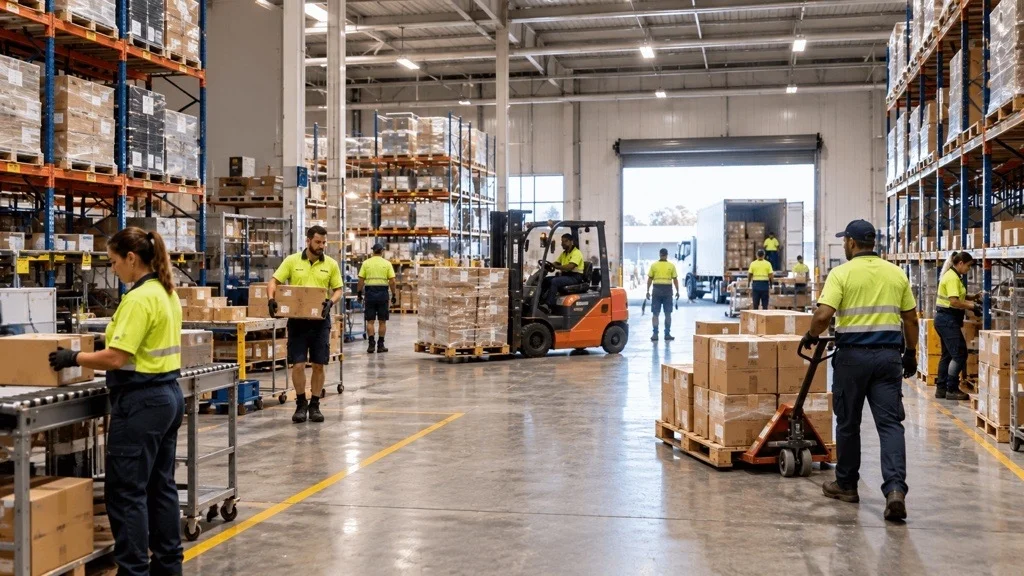

Production environments run on precise coordination. Every shift depends on the previous one being fully staffed, materials flowing on schedule, and quality checks completing on time. When a single operator calls in sick, a large order lands unexpectedly, or a packing deadline shifts forward, the ripple effect through the floor is immediate. Missed dispatch windows, backed-up production lines, and burnt-out permanent staff turn small staffing gaps into serious operational problems.
Manufacturing labour hire provides supervisors and operations managers with a direct solution - scalable, screened, and rapidly deployed workers who plug into existing production systems without the permanent headcount commitment. Brisbane factories, packing facilities, and manufacturing units increasingly rely on flexible labour to protect output during peaks, absences, and transitional periods.
This guide breaks down 7 practical ways manufacturing and production operations use labour hire to maintain steady output. Whether you run a food processing plant, packaging facility, industrial assembly line, or distribution warehouse, these strategies help you protect production without over-committing to fixed staffing.
1. Cover Predictable Shift Pressure and Peak Periods
Every production environment has predictable pressure points. End-of-month dispatch surges. Seasonal packaging peaks. New product launch runs. Contract-driven order spikes. Trying to staff for these peaks with permanent headcount creates under-utilised roles during quiet periods - while under-staffing them creates burnout and missed deadlines during busy ones.
Common peak-coverage deployments include:
- Packing and dispatch surge support
- Labelling and finishing line coverage
- Material handling during high-volume runs
- End-of-shift clean-down and reset work
- Weekend and overnight overflow shifts
Manufacturing supervisors who plan peak coverage in advance secure better-quality workers than those who make emergency requests. Labour hire providers who know your operation in advance can pre-brief teams before they arrive on-site - dramatically reducing the ramp-up time on day one.
2. Maintain Clear Reporting Lines and Site Discipline
Temporary workers deliver better results when they slot into existing site discipline rather than operating outside it. Clear reporting lines, defined task ownership, and consistent supervision keep production quality and safety standards intact even when the workforce composition changes shift to shift.
Effective integration includes:
- Named supervisor accountability for temporary crew
- Structured site induction covering safety and procedure
- Clear task allocation and quality expectation briefing
- Consistent break, meal, and shift-end protocols
- Immediate escalation paths for issues or concerns
Labour hire providers that understand production environments deploy workers who arrive expecting structure - not workers looking for direction. This is the same disciplined workforce management that applies to reception and admin labour hire for business continuity - flexible workforce succeeds through structure, not through ad-hoc deployment.
3. Protect Permanent Staff Capacity and Skill Focus
Permanent production staff typically hold specific technical skills - machine operation, quality control, line leadership, safety oversight - that take time and training to develop. When these staff get pulled into general packing, cleaning, or material movement to cover shift gaps, the business loses their high-value time and shortens their long-term engagement.
Flexible labour protects permanent capacity by:
- Handling volume-based tasks that don't require specialist skills
- Covering leave without stretching remaining team members
- Supporting production during known busy windows
- Reducing overtime pressure on permanent staff
- Freeing skilled staff to focus on technical work
Businesses that consistently over-stretch permanent teams see higher turnover, more fatigue-related incidents, and reduced production quality. Layered staffing - permanent specialists plus flexible general labour - delivers better long-term outcomes than trying to run everything through fixed headcount.
4. Support Compliance with Award and WHS Standards
Production environments operate under strict award requirements and Work Health and Safety regulations. Casual and temporary workers still need proper inductions, correct classification, valid PPE, and documented site briefings. Cutting corners on temporary worker compliance exposes the business to workers' compensation claims and regulatory penalties.
Compliance responsibilities include:
- Correct award classification and pay rates
- WHS site induction with documented completion
- PPE provision matched to production environment
- Chemical handling training where relevant
- Injury reporting protocols and incident documentation
Warehouse labour hire providers who take compliance seriously deliver documented inductions, verified qualifications, and full record-keeping. Providers who cut corners on documentation create risk exposure that outweighs any cost savings. Choosing providers carefully - similar to how facility managers approach vetting any commercial services provider - protects long-term operational integrity.
5. Maintain Safety Standards on Active Production Floors
Manufacturing and warehouse environments carry serious safety risks - moving machinery, forklifts, elevated storage, chemical exposure, high-noise areas, and shift-related fatigue. Temporary workers who don't understand site-specific hazards create risk for themselves and permanent staff. Structured safety onboarding is not optional.
Safety-focused integration includes:
- Site-specific hazard walkthroughs before shift start
- Buddy system pairing new temporary workers with experienced staff
- Clear emergency procedures and evacuation routes
- Visible signage on restricted zones and machinery
- Documented near-miss and incident reporting
Production floors share safety principles with broader facility environments - slip hazards, spill response, and structured safety protocols matter across all commercial settings. Providers who deploy workers into unfamiliar environments without proper safety briefing generate more incidents, higher workers' comp exposure, and longer-term compliance issues.
6. Scale Casual Coverage Around Real Production Demand
Production demand rarely stays flat. Contract wins, seasonal cycles, new product launches, and lost tenders all reshape workforce requirements within weeks. Locking in permanent headcount for peak demand leaves the business paying for capacity during quiet months. Casual labour hire scales workforce exactly to actual demand.
Practical scaling scenarios:
- Ramping up for new production contracts
- Coverage during known seasonal peaks
- Bridge staffing during equipment upgrades
- Backfill during permanent recruitment cycles
- Cover for training, leave, or certification renewals
Businesses that plan casual coverage in advance avoid emergency labour requests and secure higher-quality workers. Consistent providers can maintain a shortlist of pre-briefed casual workers who return regularly, familiar with site procedures and quality standards.
7. Provide Backup Coverage for Unplanned Absences
Even well-planned production schedules face unplanned disruption - sick leave, family emergencies, sudden resignations, or workers not returning after break periods. A single missed shift on a small production floor can halt an entire line. Backup labour hire coverage prevents these disruptions from cascading into missed dispatch commitments.
Standard unplanned-coverage arrangements:
- Same-day or next-day emergency deployment
- On-call worker rosters for regular clients
- Pre-briefed backup crews familiar with site procedures
- Rapid replacement if temporary workers underperform
- 24/7 coordination during high-critical production periods
Reliable providers maintain the operational capacity to respond quickly - not just when convenient. Choosing providers based on response capability rather than just hourly rate delivers dramatically better outcomes when production pressure is highest.
Common Mistakes When Using Labour Hire for Production Shifts
Even experienced supervisors make labour hire mistakes that undermine production consistency. Being aware of these helps you get real value from flexible workforce:
- Requesting workers without task-specific briefing. Generic "we need three hands for the floor" requests deliver mismatched candidates. Task-specific briefings (packing, labelling, dispatch, quality checks) produce better matches.
- Skipping site inductions to save time. Untrained workers on active production floors create safety incidents that cost far more than the induction time saved. Never deploy workers straight to the line without proper briefing.
- Choosing on hourly rate only. The cheapest labour hire options typically deliver workers who need constant supervision, produce more errors, and generate more turnover. Total productivity per shift matters more than hourly rate.
- Not building a preferred worker pool. Repeatedly requesting different workers means starting from scratch every shift. Providers who can supply the same familiar workers over time deliver better output faster.
- Failing to document performance issues. Unrecorded performance concerns keep repeating with each new deployment. Communicating specific issues to the provider improves future placements dramatically.
Ready to Protect Production Output with Reliable Labour Hire?
Manufacturing labour hire shouldn't feel like a lottery every shift. YOT Services delivers screened, briefed, and role-ready production workers across Brisbane and wider Queensland - including warehouse labour hire, factory support, packing crews, and dispatch coverage. Every deployment includes structured site induction, WHS compliance, and clear supervisor coordination.